Our patient is a 42 year-old male recreational runner complaining of posterior heel pain. His symptoms – pain during running and stair climbing, tenderness upon palpation, and early morning stiffness – had persisted for the past 8 months. He had a history of running overload.
The patient had sought treatment at another clinic, with no satisfactory results. Based on reported symptoms and MRI results, he had been diagnosed with mid-portion Achilles tendinopathy, and treated with conservative care,
His treatment protocol included:
Despite treatment, his symptoms persisted, and even worsened slightly after shockwave therapy.
During the clinical exam, we questioned the patient to obtain more details about the quality and distribution of his pain. He described the pain as “burning and sharp,” and radiating toward the lateral foot. The foot was hypersensitive to pressure from socks and footwear, and he reported nighttime discomfort. An inverted ankle stretch worsened his pain symptoms.
A focused physical exam revealed:
At this point we suspected sural nerve entrapment.
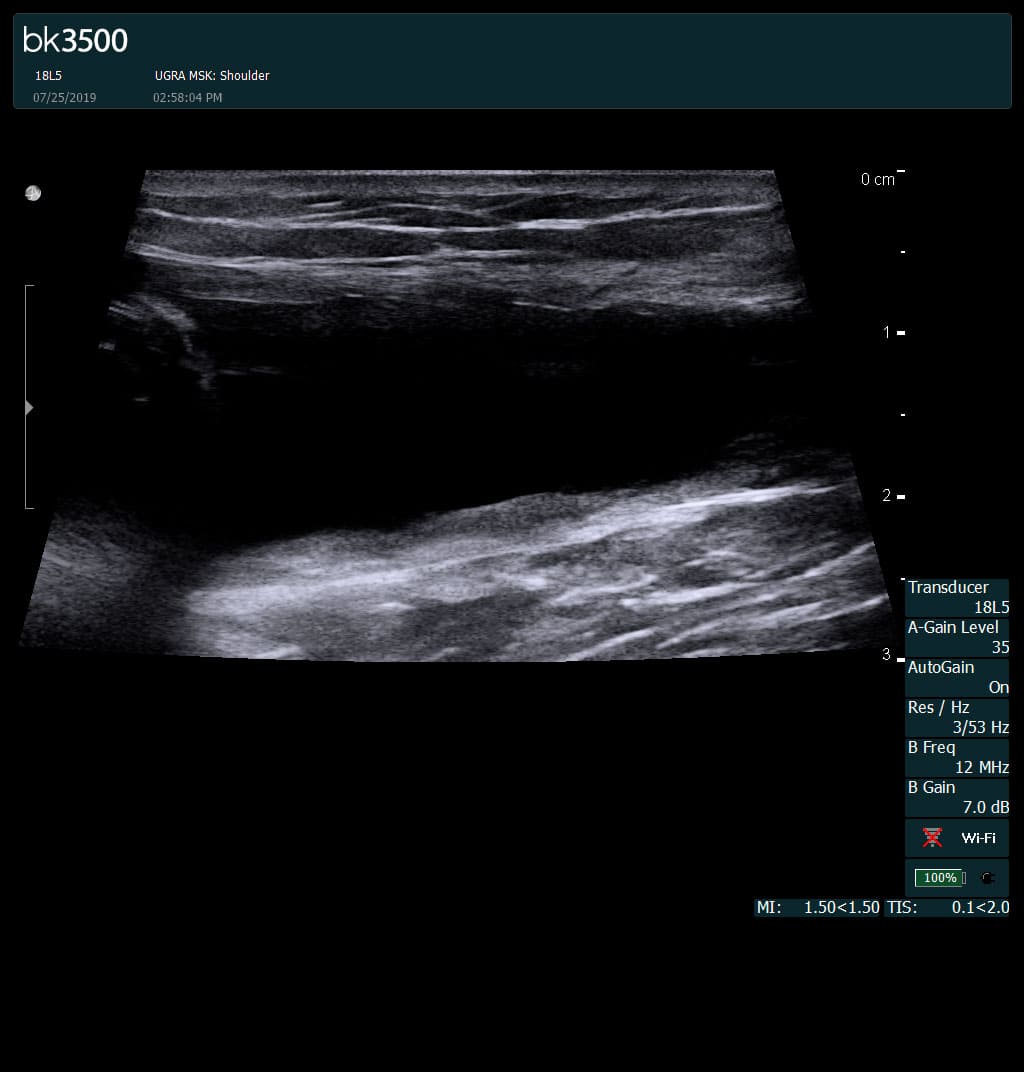
Diagnostic ultrasonography confirmed our suspicions:
The sural nerve appeared to be entrapped at the fascial crossing, posterior to the lateral malleolus, with symptoms mimicking Achilles tendinopathy.
To release the nerve and restore gliding, we performed an ultrasound-guided hydrodissection procedure. We positioned the needle superior to the nerve and injected a 5% dextrose solution (D5W), with a small amount of hyaluronic acid. The procedure successfully released the nerve, resulting in immediate pain relief.
The patient saw a 70% improvement within 48 hours, and reported 90-100% pain resolution at the 2-week follow-up. He was able to return to a progressive running program, and was completely asymptomatic at the 3-month follow-up.
Prior to visiting our clinic the patient had sought treatment elsewhere, where he received shockwave and radiofrequency therapy, and physical therapy. Due to misdiagnosis, the shockwaves were directed at the Achilles tendon, and not the nerve, failing to provide relief. Radiofrequency therapy provided minor temporary relief, but was ineffective in decompressing the nerve. During physical therapy, the eccentric loading protocol increased tension on the nerve, exacerbating irritation.
Rather than proceeding with the initial diagnosis, we took a closer look at the pain quality and location, and used dynamic ultrasonography to uncover the true pathology – an entrapped sural nerve.
Doctors are often quick to diagnose posterior heel pain as Achilles tendinopathy, and in this case, abnormal MRI results — which are common in asymptomatic runners — contributed to the misdiagnosis. When the problem is neural entrapment, treatment directed at the tendon is bound to fail.
In our case, proper and thorough diagnosis backed by dynamic ultrasonography led to appropriate and successful treatment, with a single injection completely resolving the patient’s condition.
Dr. Lev Kalika is a world-recognized expert in musculoskeletal medicine. with 20+ years of clinical experience in diagnostic musculoskeletal ultrasonography, rehabilitative sports medicine and conservative orthopedics. In addition to operating his clinical practice in Manhattan, he regularly publishes peer-reviewed research on ultrasound-guided therapies and procedures. He serves as a peer reviewer for Springer Nature.
Dr. Kalika is an esteemed member of multiple professional organizations, including:

Below is a prime example of how ultrasound can take the guesswork out of diagnosis.

A bad physical therapy experience is one of the primary causes of unnecessary surgery

In this instance, an athlete was originally diagnosed with minor quadriceps muscle strain and was treated for four weeks, with unsatisfactory results. When he came to our clinic, the muscle was not healing, and the patients’ muscle tissue had already begun to atrophy.
Upon examination using MSUS, we discovered that he had a full muscle thickness tear that had been overlooked by his previous provider. To mitigate damage and promote healing, surgery should have been performed immediately after the injury occurred. Because of misdiagnosis and inappropriate treatment, the patient now has permanent damage that cannot be corrected.
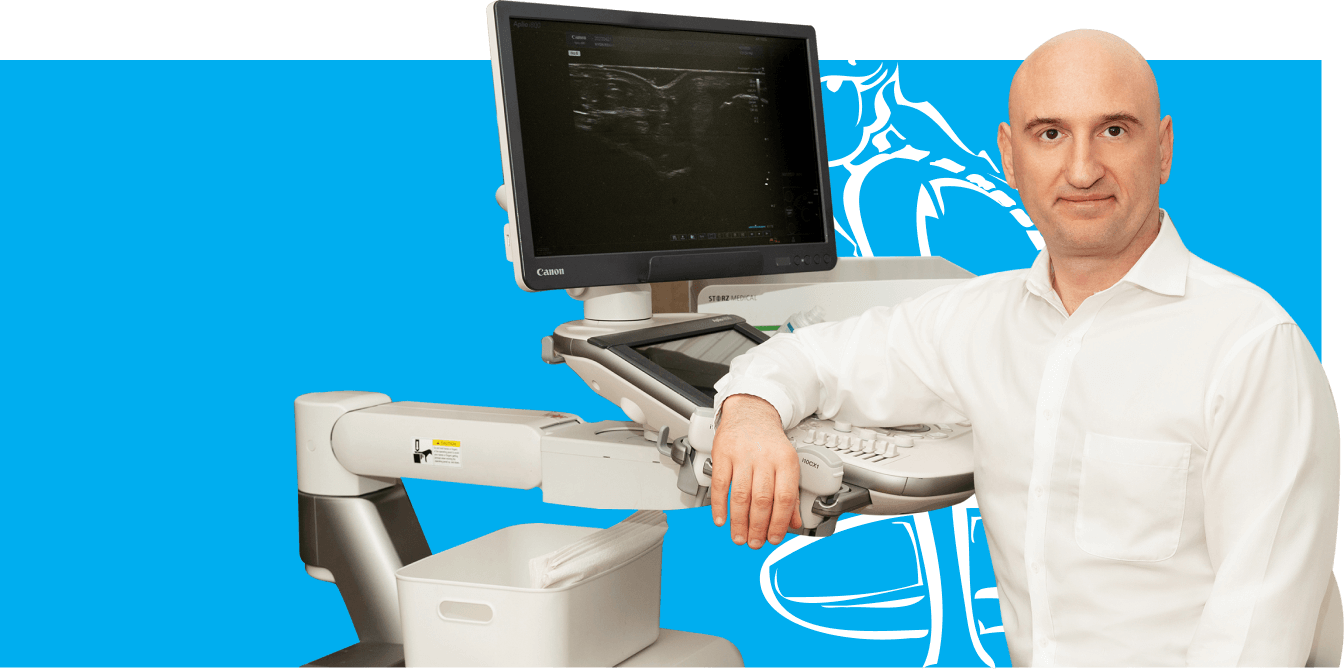
The most important advantage of Ultrasound over MRI imaging is its ability to zero in on the symptomatic region and obtain imaging, with active participation and feedback from the patient. Using dynamic MSUS, we can see what happens when patients contract their muscles, something that cannot be done with MRI. From a diagnostic perspective, this interaction is invaluable.
Dynamic ultrasonography examination demonstrating
the full thickness tear and already occurring muscle atrophy
due to misdiagnosis and not referring the patient
to proper diagnostic workup
Demonstration of how very small muscle defect is made and revealed
to be a complete tear with muscle contraction
under diagnostic sonography (not possible with MRI)
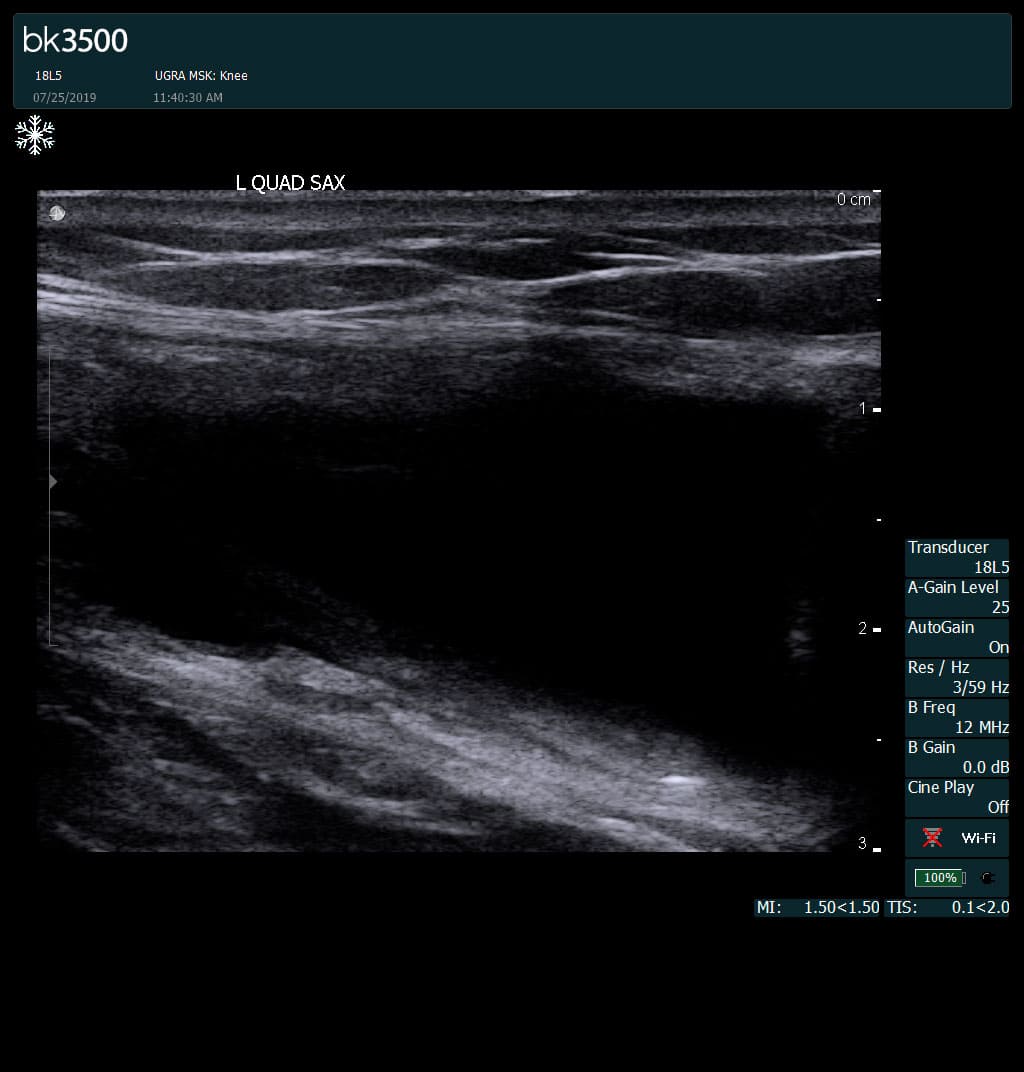
Complete tear of rectus femoris
with large hematoma (blood)
Separation of muscle ends due to tear elicited
on dynamic sonography examination


 Request Telehealth