You probably know what it feels like. The headache at the back of your head after spending a long day at the computer. Perhaps your shoulders round forward without you realizing, or you get up in the morning and find them stiff and it takes you an hour to get them going. “tech neck” is a catch-all phrase for a group of symptoms that are becoming a common issue for those who spend hours a day on their phones, tablets and computer screens.
Here’s where it gets complicated. What you read online about tech neck is a blend of good science and oversimplification. Some claims are flat-out wrong. Some are at least correct but lack context that alters the way one should respond.
This article explores the facts of what the peer-reviewed research has to say about screen time, cervical spine (neck) loading, posture and chronic neck pain, and what that means for you.

The term is not a clinical diagnosis. “Tech neck” is not a term used by doctors in the ICD-10 (International Classification of Diseases coding system). These are replaced by the terms cervicogenic headache (headache from the neck), cervical myofascial pain (muscle-related pain in the neck region), cervical radiculopathy (nerve root irritation resulting in arm pain or numbness) and non-specific neck pain.
The informal label is helpful for communication with the public. But it gives a false impression of simplicity – that one cause leads to one condition, which leads to one fix.

A systematic review and meta-analysis of the relationship between smartphone use and neck pain showed that there was a consistent relationship between prolonged smartphone use and neck symptoms, but that the duration of use was not the complete picture. All of these contribute to posture while using it, frequency of breaks, and individual biomechanical factors.
The weight of your head is about 10 to 12 pounds when it is in a neutral position. The forward motion adds a great deal of weight to your cervical spine. A 2014 study by Hansraj in Surgical Technology International estimated that the effective load on the cervical spine can increase to about 60 lbs when the angle of the forward gaze is 60 degrees.

Hansraj’s figures have been a subject of debate, with some biomechanists saying that the model simplifies the loading dynamics in the spine, but the basic idea is correct. Non-neutral postures that are held for a long time put a greater mechanical strain on the cervical muscles, ligaments, and discs.
A biomechanical model of loading of the neck later showed that flexing the neck increases the compressive forces and shear forces throughout the cervical levels (the joints between vertebrae) and that the deep muscles exert more force as the neck flexes. The effect is cumulative: the longer the time in the flexed position, the more the total load.
Often a non-traumatic injury. Frequently a result of strain over weeks and months.
This is one of the longest-standing misconceptions in musculoskeletal health. In the laboratory, extreme cervical flexion does lead to increased spinal loading, but in real-world populations the link between static posture and chronic pain is much more tenuous.
A systematic review and meta-analysis of the association between forward head posture and neck pain published in 2019 revealed a weak association with a strong age confounding. In real-world populations, psychosocial factors, work stress, sleep quality and physical activity levels are correlated with chronic neck pain to a similar extent as static alignment.
The current research evidence is that it’s not about one posture, it’s about postural variability, or the lack of it. Even a good posture can cause tissue fatigue when it is maintained for a long time.


Screen time is one of the factors. Full stop. However, the increase in neck pain complaints due to smartphones or computers alone overlooks several other factors that have been identified in research.
In a systematic review of the effects of sedentary activity and upper-body disorders in office workers, the authors concluded that there was a relationship between sedentary activity and neck and shoulder complaints, not only with screen-specific activity. Risk is attributable to the demands of the job, psychological stress, and physical fitness.
The screen is often where the pain happens to appear. It’s usually not the sole cause.


Neck strengthening exercises are a valid treatment. This is backed up by the research. Though the rehabilitation concept as a mere strength deficit is incomplete.
A multimodal program (a combination of cervical endurance, thoracic mobility (movement through the mid-back), and scapular (shoulder blade) stabilization) is recommended over neck strengthening alone in chronic neck pain, as suggested by clinical practice guidelines and more recent systematic reviews.
Strength matters. So does the movement of the whole upper quadrant.


Sitting time is decreased and standing desks could be beneficial for cardiovascular health. There is mixed evidence for the specific reduction of neck pain.
Neck and shoulder muscle activity is not completely removed when sitting to standing, and static standing when the head is forward causes a similar cervical loading as seated posture. Studies of ergonomic changes for office workers show that the evidence for reducing pain is weak overall and that reducing the height of the work surface is not as important as increasing the frequency of movement.
The same issue at a different altitude.


There is no value in stretching. Stretching of the cervical and thoracic regions can help decrease perceived muscle tension and increase range of motion. Yet evidence indicates that passive stretching, without attention to the brain-to-muscle coordination system (neuromuscular control), and movement patterns, has limited long-term benefits.
New exercise research for chronic neck pain shows that active exercise, including motor control training (exercises to learn how to use muscles in specific patterns) and resistance exercise, is effective, and stretching alone has little long-term benefit.


Frequent micro-breaks from sustained postures is the intervention that has been discussed the most in the field of occupational health. The overall evidence in a Cochrane review of ergonomic interventions for office workers is limited, and the evidence for organizational measures, like supplementary breaks, is low quality. Despite this, static loading breakers are a low-risk, feasible approach.
A practical and common guideline is to break after every 30-45 minutes. Occupational health guidance (OSHA / NIOSH) also indicates that breaks can help alleviate musculoskeletal discomfort for screen users without negatively impacting productivity.
Conservative treatment for neck pain is based on exercise. Recent clinical practice guidelines suggest that exercise, such as strengthening and mobility exercises of the cervical spine, is a first-line treatment for non-specific neck pain.
There are programs that have proven to be effective in recent trials, such as:
The height of the screen, distance to the screen, and chair support are important. The aim is not to get a perfect static posture, it is to minimise the need to maintain a static posture for long periods. OSHA ergonomics guidance suggests that the height of the monitor should be at or below eye level and that the keyboard and mouse positions should be such that shoulders remain relaxed.
The 2017 APTA/JOSPT neck pain clinical practice guideline supports manual therapy, specifically cervical and thoracic manipulation and mobilization (hands-on joint movement techniques) as an adjunct to exercise. It is not recommended as a standalone long-term treatment.
The relationship between chronic neck pain and workload, anxiety and sleep quality is similar, not mechanical. Factors that are more likely to predict persistence of neck pain include psychological distress and pain catastrophizing, while poor sleep quality is linked to chronic neck pain and slower recovery. Less exposure to stressors, and a regular sleep schedule, decreases general nervous-system sensitization (the system’s sensitivity to pain). When the muscle tension resulting from mental strain has subsided, exercise tends to be more effective.


Not all presentations of neck pain warrant medical evaluation prior to starting an exercise or manual therapy program.
Do not self-manage if you have:


Most individuals with complaints associated with tech-neck benefit from conservative treatment. However, certain conditions related to cervical spine disease do need medical or surgical treatment.
If conservative treatment for 6-8 weeks does not resolve the cervical radiculopathy, MRI (magnetic resonance imaging) is usually performed to help evaluate the condition and surgical decompression may be an option in selected cases.
Cervical myelopathy (spinal cord compression resulting in weakness, coordination problems, or gait changes) is a surgical disorder. The clinical practice guideline for degenerative cervical myelopathy (DCM) from the AO Spine suggests that moderate to severe disease is a suitable indication for surgical decompression, and evidence shows that earlier intervention yields better results.
If structural disc pathology is seen on imaging with associated neurological deficits, spine surgery consultation may be warranted.
But the majority of tech neck presentations do not need surgery, that does not mean that surgery is never appropriate. A referral to a specialist is indicated urgently for any case with progressive neurological symptoms.
NYDNRehab has treated patients with neck pain ranging from mild occupational strains to post-surgical rehab. The approach is based on available evidence and not on a protocol.
The initial evaluation includes high-resolution dynamic ultrasonography (real-time imaging of soft tissue structures during movement) of the cervical muscles, tendons and fascial (connective tissue) layers. This tells you if it is myofascial, joint, neural, or all three.
Treatment programs can include:


Treatment also transcends the ultrasound images to the person and their routine. Rehabilitation here is NOT just neck training. Clinicians discuss your actual work demands, how to include micro-breaks in a stressful office day and how to release the general muscle tension that accumulates with mental fatigue and burnout.
The aim is not to get rid of forward head posture in your life. It’s not realistic or evidence-based. The objective is to get movement tolerance, decrease sensitized tissue and develop the ability to sit at a screen without accumulating strain.
No, for most people. Chronic postural strain does not usually cause permanent structural changes unless there is a significant amount of disc or facet joint degeneration (wear-related joint breakdown). However, chronic loading of the cervical spine can contribute to increased degeneration if not treated over the years.
Honestly, it varies. Most clinical trials report that structured programs achieve meaningful pain reduction at 6-12 weeks. The program is not as important as compliance.
Far less than most people think. A pillow which maintains a neutral position of the neck is beneficial, but not the most important factor of sleep quality and duration. Chronic short sleep and overnight stress increases the sensitivity of pain receptors in the trapezius and suboccipital (base-of-skull) muscles, which may cause even a neutral posture at your desk to feel sore the next day.
Probably, for overall health. Only if associated with regular movement habits, for neck pain specifically. A rigid standing desk for 4 hours is the same cervical loading as a rigid chair for 4 hours.
There are no current guidelines to suggest routine imaging for non-specific neck pain without red flag symptoms or progressive neurological signs. Disc bulges and other findings are frequently found in asymptomatic adults and do not necessarily account for symptoms. This will be determined by your complete clinical history by your clinician.
Whether you’re suffering from chronic neck pain due to screen-related postures, work-related postures or something else, the NYDNRehab team is here to help you through it with a structured and evidence-based approach.
Request an appointment»

Our location: 11 West 25th Street 5th floor, New York, NY 10010
Dr. Lev Kalika is a world-recognized expert in musculoskeletal medicine. with 20+ years of clinical experience in diagnostic musculoskeletal ultrasonography, rehabilitative sports medicine and conservative orthopedics. In addition to operating his clinical practice in Manhattan, he regularly publishes peer-reviewed research on ultrasound-guided therapies and procedures. He serves as a peer reviewer for Springer Nature.
Dr. Kalika is an esteemed member of multiple professional organizations, including:

Below is a prime example of how ultrasound can take the guesswork out of diagnosis.

A bad physical therapy experience is one of the primary causes of unnecessary surgery

In this instance, an athlete was originally diagnosed with minor quadriceps muscle strain and was treated for four weeks, with unsatisfactory results. When he came to our clinic, the muscle was not healing, and the patients’ muscle tissue had already begun to atrophy.
Upon examination using MSUS, we discovered that he had a full muscle thickness tear that had been overlooked by his previous provider. To mitigate damage and promote healing, surgery should have been performed immediately after the injury occurred. Because of misdiagnosis and inappropriate treatment, the patient now has permanent damage that cannot be corrected.
The most important advantage of Ultrasound over MRI imaging is its ability to zero in on the symptomatic region and obtain imaging, with active participation and feedback from the patient. Using dynamic MSUS, we can see what happens when patients contract their muscles, something that cannot be done with MRI. From a diagnostic perspective, this interaction is invaluable.
Dynamic ultrasonography examination demonstrating
the full thickness tear and already occurring muscle atrophy
due to misdiagnosis and not referring the patient
to proper diagnostic workup
Demonstration of how very small muscle defect is made and revealed
to be a complete tear with muscle contraction
under diagnostic sonography (not possible with MRI)
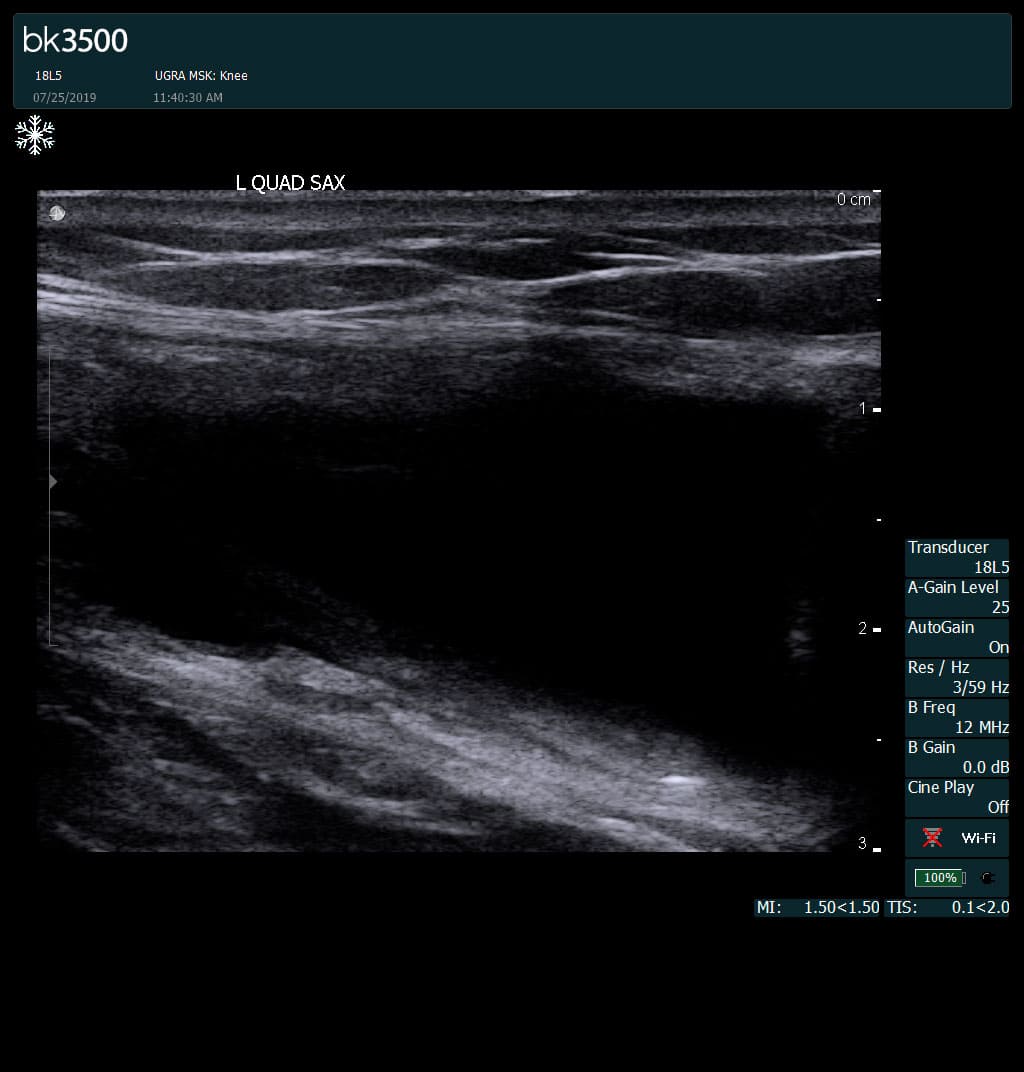
Complete tear of rectus femoris
with large hematoma (blood)
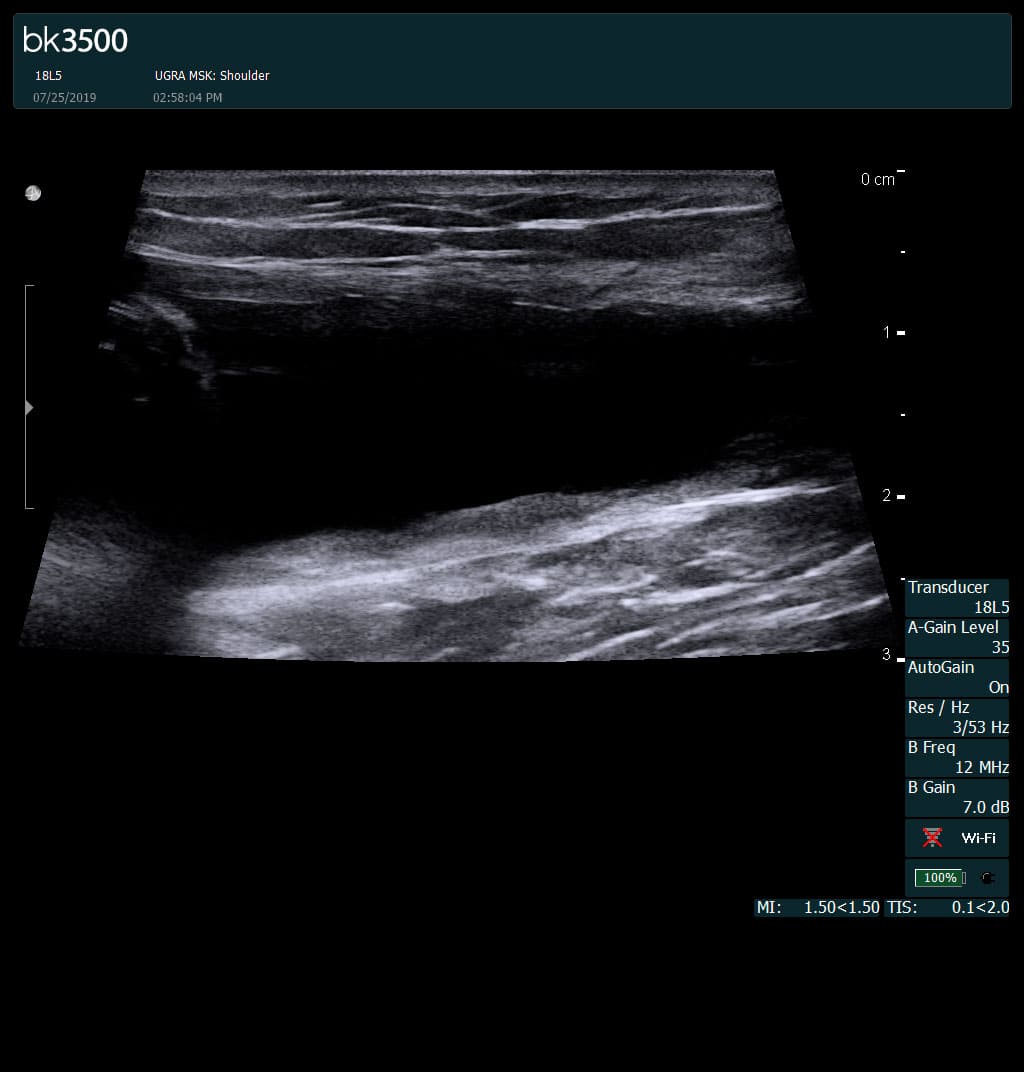
Separation of muscle ends due to tear elicited
on dynamic sonography examination


 Request Telehealth